
Per-Company vs Per-User Pricing: Which ERP Model Saves You Money?
The hidden math of ERP pricing
When you see "$25/user/month" on an ERP pricing page, it sounds affordable. But is it? Let's do the math that vendors hope you won't.
A growing retail business with 10 employees — a manager, 3 salespeople, 2 warehouse staff, 1 accountant, 1 purchaser, and 2 cashiers. At $25/user/month, that's $250/month or $3,000/year.
Now imagine that same business using a per-company model at $79/month flat. That's $948/year — less than a third of the per-user cost.
The difference becomes even more dramatic as you grow.
The real cost comparison
| Team Size | Per-User ($25/user) | Per-Company (flat) | Annual Savings |
|---|---|---|---|
| 3 users | $75/mo ($900/yr) | $29/mo ($348/yr) | $552 |
| 5 users | $125/mo ($1,500/yr) | $29/mo ($348/yr) | $1,152 |
| 10 users | $250/mo ($3,000/yr) | $79/mo ($948/yr) | $2,052 |
| 15 users | $375/mo ($4,500/yr) | $79/mo ($948/yr) | $3,552 |
| 25 users | $625/mo ($7,500/yr) | $199/mo ($2,388/yr) | $5,112 |
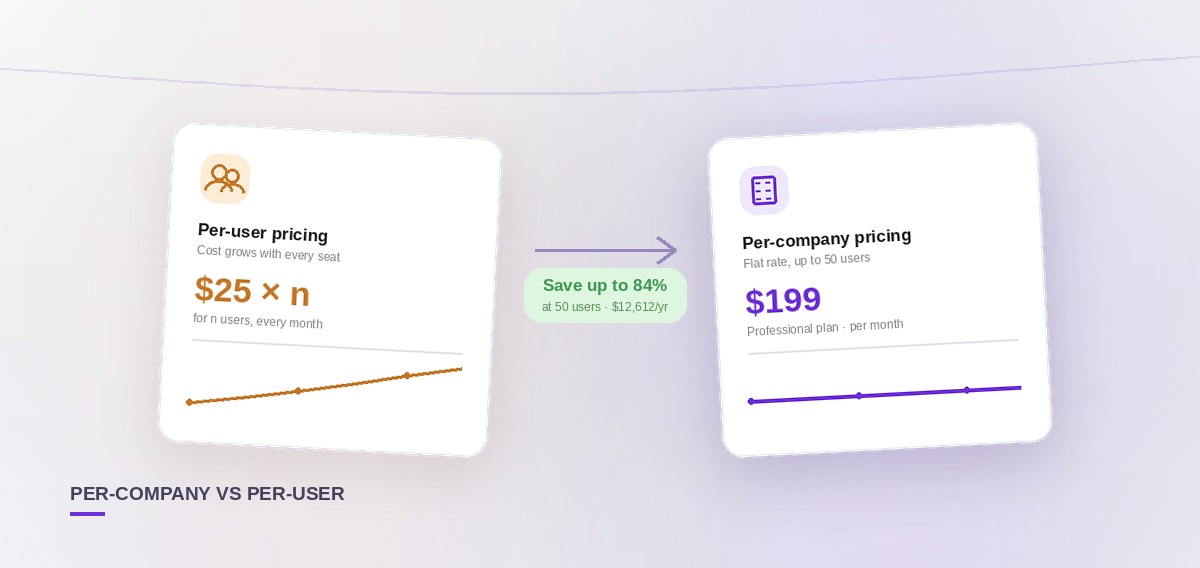
| 50 users | $1,250/mo ($15,000/yr) | $199/mo ($2,388/yr) | $12,612 |
At 50 users, per-company pricing saves you $12,612 per year. That's the salary of an additional employee.
The hidden costs of per-user pricing
The "admin tax"
Most per-user models charge for every user who logs in — including your IT administrator, your accountant who checks reports once a week, and the intern who needs view-only access for a month. These low-usage users cost the same as your power users.
The growth penalty
Per-user pricing punishes growth. Every new hire increases your software cost. Business owners start making irrational decisions: "Can we share a login?" (security risk), "Does the new cashier really need access?" (yes, they do), "Let's wait to add them until next month" (lost productivity).
The inactive user drain
Employees leave. Roles change. But in many per-user systems, you're billed until you manually deactivate the account. A forgotten inactive user costs you $25/month indefinitely.
The regional multiplier
Per-user pricing is set by Silicon Valley companies for Silicon Valley budgets. $25/user/month might be negligible in San Francisco, but for a Tunisian SMB, $250/month for 10 users represents a significant expense.
How per-company pricing works
The per-company model charges one flat fee regardless of how many users you have (up to a tier limit). You choose your plan based on the features you need, not the number of people on your team.
For example, a platform like Inflexions structures its pricing as:
- Free: 2 users, basic features — forever, $0
- Starter: Up to 5 users, full sales + purchases + inventory — $29/month
- Standard: Up to 15 users, adds accounting — $79/month
- Professional: Up to 50 users, adds HRM + API — $199/month
The jump from 5 to 15 users costs you $0 extra if you're already on Standard. You just add the users and they start working.
When per-user pricing makes sense
To be fair, per-user pricing isn't always wrong. It works well for:
- Very small teams (1-2 users) where the per-user cost is minimal
- Enterprise tools where each user represents significant infrastructure cost
- Tools with heavy per-user resource usage (video conferencing, design tools)
For an ERP — where the database, the business logic, and the infrastructure are shared regardless of user count — per-company pricing is almost always more cost-effective for SMBs.
The comparison vendors don't want you to make
When evaluating ERPs, don't compare the advertised starting price. Compare the total cost for your actual team size:
- Count every person who needs access (even view-only)
- Multiply by the per-user price
- Compare to the flat per-company price at the equivalent tier
- Project forward: what happens when you hire 5 more people?
Most SMBs discover that per-company pricing costs 50-80% less over a 3-year period.
What to look for beyond price
Price is important, but not everything. Also consider:
- Implementation fees: Some ERPs charge $5,000-$100,000 just to set up. Look for self-service onboarding with zero implementation cost.
- Annual vs monthly: Annual billing often saves 15-20% (typically 2 months free).
- Hidden modules: Some vendors charge extra for inventory, accounting, or reporting. Look for all-inclusive plans.
- Contract length: Avoid long-term commitments. Monthly billing with cancel-anytime gives you flexibility.
The bottom line
Per-user pricing is a legacy model from the era of on-premise software, where each user needed a separate license key. In the cloud era, the marginal cost of adding a user is close to zero — but the marginal price to you is $25/month.
Per-company pricing aligns the vendor's incentive with yours: they want you to use the product more (higher engagement = lower churn), so they don't penalize you for adding users.
Choose the model that rewards your growth instead of taxing it.
Ready to take action?
Try Inflexions for free — no credit card, no installation.